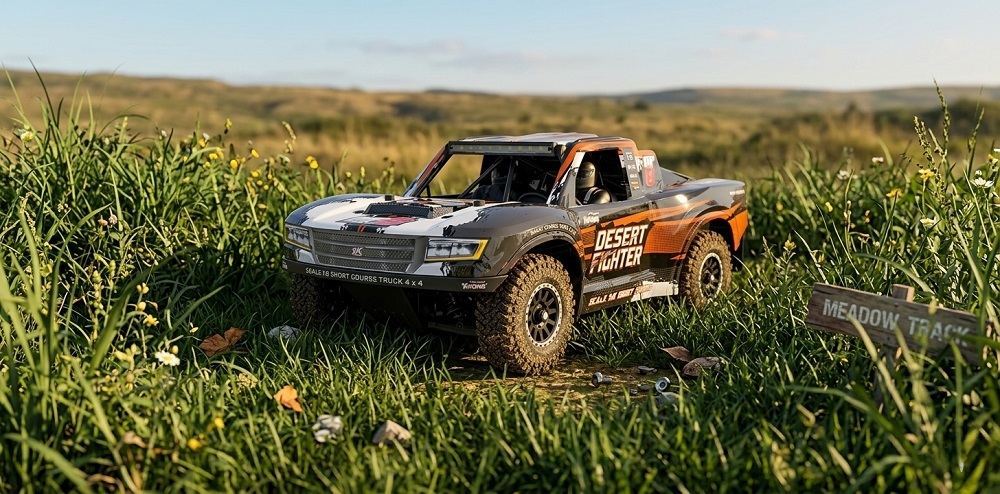
YIKONG YK8081 desert short-course truck typically features a high-strength nylon roll cage inside its PC body or mounted on the chassis. This roll cage not only enhances the vehicle’s realistic appearance but also protects the body and internal electronic components in the event of a rollover.
SUCHIYU 10101 is powered with 550 brushed motor and 60A ESC, runing time 12 minutes. RC scene right now, and if you’re looking for a solid backyard basher, SUCHIYU 10101 deserves a prime spot on your radar. Whether you’re a total newcomer to the hobby or a seasoned RC guy looking for a tough, affordable rig to hand off to the kids on a Sunday afternoon, this 1/10 scale 4WD brushed monster truck brings some serious value to the table. Let’s dive into the specs, see what makes this rig tick, and find out if it’s worth your hard-earned cash.
Size, Stance, and Weight
First off, let’s talk about the sheer footprint of this thing. Sitting at 430mm long and 300mm wide (roughly 17 by 11.8 inches for us stateside folks), it has that classic, aggressive 1/10 scale stance that just looks awesome sitting in the dirt.
But what really surprised me is the weight—this truck tips the scales at a hefty 2820 grams (over 6.2 lbs!). That’s a lot of beef for a brushed rig, and honestly, that weight works in its favor. It keeps the chassis planted when you’re tearing up loose gravel and helps it plow through tall grass. The massive 110mm tall and 60mm wide tires give it insane ground clearance and grip, while the 270mm wheelbase and 245mm track width keep it surprisingly stable through the corners.
Under the Hood: Power & Speed
Alright, let’s get into the guts of the truck. Powering the SUCHIYU 10101 is a torquey 550 brushed motor spinning at 16,000 RPM. Out of the box, it hits a top speed of 33+ km/h (just north of 20 mph). Now, 20 mph might not sound face-melting to you 8S speed-run guys, but for backyard bashing, hitting dirt jumps, and ripping up trails, it’s plenty fast and super controllable.
The juice is managed by an integrated 60A ESC. I need to give you guys a major heads-up here: this ESC is strictly a 2S setup. Do not try to slap a 3S LiPo in this rig thinking you’ll get a speed boost, or you’ll be letting out the magic smoke. It’s designed for durability and reliability on a 2S platform, so stick to the recommended voltage.
Handling & Range
Taming a 6-pound 4WD truck takes a decent steering setup, and SUCHIYU didn’t cheap out here. They threw in a 6KG digital servo, which provides crisp, responsive steering compared to the mushy analog servos you usually find in this price bracket. You can throw it into a dirt slide and counter-steer with total confidence.
The 2.4GHz transmitter gives you a solid control distance of over 100 meters (about 330 feet). Unless you have eagle eyes, that’s way further than you’ll ever comfortably drive a 1/10 scale truck anyway. No signal drops, no glitching—just pull the trigger and go.
Battery Life & Charging
The rig comes with a standard 7.4V 2300mAh 30C LiPo battery. I absolutely love that they used an XT60 connector right out of the box—it’s an industry standard, meaning you won’t have to solder on new plugs to run aftermarket packs. You’re going to get about 12 minutes of hard bashing out of a single charge, which is pretty standard for a heavy brushed truck.
The only real bummer here is the included charger, which takes about 3.5 to 4 hours to juice the battery back up. If you’re serious about getting into the hobby, do yourself a favor: grab a fast smart charger and a couple of spare 2S LiPos so you can keep the bash session going all afternoon.
The Final Verdict
So, what’s the bottom line? SUCHIYU 10101 is a tough-as-nails, heavy-duty 4WD basher that punches way above its weight class. It’s not trying to be a $600 brushless race buggy; it’s an honest, fun, and durable truck that’s perfect for tearing up the local park, hitting some BMX jumps, or just goofing off in the driveway. If you want a 1/10 scale truck with awesome out-of-the-box presence, solid brushed power, and a price tag that won’t make your wallet cry, this rig is a total winner. Grab your transmitter, get outside, and go break some parts!
MJX Hyper Go has officially begun preparations for the launch of MJX Hyper Go 16213 RC car.
The upcoming MJX Hyper Go 16213 RC car will be available in two colors: blue and black. MJX Hyper Go 16213 RC car is equipped with a 2845 4300KV motor and a 45A independent ESC, and its 7.4V 2000mAh battery provides 18 minutes of runtime.
Recently, a lot of beginners have been asking me: “I have a limited budget and want an RC car that can bash, hit jumps, run fast, and take a beating without breaking easily. Which one should I choose?” My answer is always the same: MJX Hyper Go 10210.
As a model that became a massive hit right after its release, it perfectly solves all the pain points for beginners entering the hobby: it’s budget-friendly, fully loaded with features, highly durable, easy to repair, and versatile in how you can drive it. Today, from a beginner’s perspective, I’m giving you the most comprehensive buyer’s guide to help you avoid common pitfalls and pick the version that suits you best.
Why highly recommend the MJX Hyper Go 10210 for beginners?
Before making a recommendation, let’s talk about why this car is the best fit for novices:
Extremely low barrier to entry: It is Ready-to-Run (RTR) right out of the box. No assembly or tuning is required—just unbox, charge the battery, and drive.
High tolerance for mistakes: The chassis is incredibly strong. Even if you crash and break something, replacement parts are super cheap, often costing just a few bucks to fix.
Versatile driving styles: It can kick up dust (bashing), hit jumps, run on tracks, and pop wheelies. You get to experience the vast majority of RC fun with just one car.
Great upgrade potential: From running 3S to 4S, from bone-stock to fully modded, it will grow with you as you transition from a novice to a veteran.
Excellent after-sales support: As a major manufacturer, MJX Hyper Go has an abundant supply of spare parts. Almost every single component can be purchased separately.
2. Which version should you choose? With or without a battery?
This car comes in two versions, and many beginners aren’t sure which one to pick. Let me clear it up for you:
Version without a battery (Roller/ARTR): Suitable for experienced players who already own other RC cars and have spare 3S or 4S LiPo batteries lying around.
Version with a battery: Highly recommended for all beginners. Although it costs a bit more, the factory-included 3S 5000mAh “Snail” brand battery is of fantastic quality. Its capacity is true to its label, the discharge rate is stable, and it’s highly versatile—you can use it in almost any 1/10 scale rally car, short course truck, or monster truck in the future. Buying a battery of this spec separately would cost you a decent chunk of change, making this bundle feel like you’re getting a free charger thrown in.
3. Must-Read Pitfall Avoidance Guide for Beginners
Many beginners make a few common mistakes when they first get their hands on a car, leading to unnecessary damage. Here is some preventative advice to save you a headache:
Always install the wheelie bar first: The manufacturer includes a note in the box strongly advising you to install the wheelie bar before driving. If you don’t, the car will easily scrape its rear on the ground when popping a wheelie, smashing up the body shell and the rear wing. Installation is super easy—just four screws and you’re done.
Stick to 3S first; don’t jump straight to 4S: The reason the manufacturer doesn’t heavily advertise 4S support is that they are afraid beginners won’t be able to handle it. On 3S, a top speed of 63 km/h (approx. 39 mph) is already extremely fast for a novice and will keep you entertained for at least half a year. Wait until your skills improve and you can easily control it on 3S before trying a 4S setup.
Tune the shocks right out of the box: The stock shocks are set up very soft from the factory, meaning the chassis will easily bottom out over jumps. When you get the car, turn the threaded shock collars down a few turns on all four corners to stiffen the preload. This will massively improve stability when launching off ramps.
Use the trick for removing/installing the body shell: Many beginners complain that the body shell is hard to snap on. There’s actually a little trick: first, align the front lip/tabs of the body shell and slot them into the chassis, then press down on the rear clips. It goes on very easily this way.
Avoid holding full throttle when the car is stuck (binding): Especially on 3S and 4S, continuously holding full throttle when the wheels are jammed will cause the motor and ESC to overheat, triggering thermal protection mode.
4. Frequently Asked Questions (FAQ)
Q: How long is the run time? How is the battery life?
A: With the stock 3S 5000mAh battery, you can get about 20–25 minutes of run time with mixed, medium-throttle driving. If you are doing full-throttle, aggressive jumping, expect about 10–15 minutes. I recommend buying an extra battery for uninterrupted fun.
Q: Is the stock steering servo good enough? Does it need an upgrade?
A: It is absolutely sufficient. The 35KG high-torque servo provides powerful and highly responsive steering. In its stock state, there is no need to upgrade. You only need to consider upgrading to a higher-torque servo if you swap out for heavier tires or engage in extremely hardcore bashing.
Q: What parts are beginners most likely to break?
A: The most commonly damaged items are the body shell, tires, and the wheelie bar—these are normal consumables. The chassis and drivetrain are incredibly tough and very hard to break under normal use. The manufacturer even includes extra shock spring retainers and rod ends (the parts most prone to snapping), so you basically don’t need to stock up on spare parts right away.
Q: What are its advantages compared to other vehicles in the same price range?
A: Its biggest advantages are its electronics and drivetrain. Most other cars in this price bracket still give you a 100A ESC, a 25KG servo, and plastic gears. However, the MJX Hyper Go 10210 steps it up with a 120A ESC, a 35KG servo, and chrome steel gears. It also supports Bluetooth tuning and is 4S capable, making its cost-to-performance ratio far superior to the competition.
5. Final Conclusion
The MJX Hyper Go 10210 is, without a doubt, the absolute best entry-level RC car you can buy in its price bracket right now. It accurately hits every single requirement a beginner has: it’s affordable, highly durable, easy to fix, versatile to drive, and has massive upgrade potential.
If this is your first time getting into the RC hobby and you don’t know what car to buy, you can confidently buy the MJX Hyper Go 10210 with your eyes closed. It will not disappoint you, and it will deliver the purest RC fun.
MJX Hyper Go has recently unveiled MJX Hyper Go 10304 rc car, a 1:10 scale Volkswagen Polo-licensed rally car. However, this model is not yet available for purchase. Interested buyers can click the link below to pre-order.
What are the highlights of MJX Hyper Go 10304 RC car?
MJX Hyper Go 10304 RC car features a 3mm metal chassis, an 80A sensorless ESC, 3652 3200kv motors with cooling fans (supports 2-3S batteries), standard front and rear metal anti-roll bars, metal suspension arms, metal second-floor mount, 12mm metal coupling, 48P metal large gear, servo saver, and a dedicated receiver with gyro.
MJX Hyper Go 10304 RC car’s wheelbase is adjustable between 257-260mm, with a width of 190mm. Included accessories: body pillars, basic tools, 500-concentration suspension oil, one set of springs, and one set of spare tires.
MXJ Hyper Go has recently launched MJX Hyper Go 10303 rc car.
First, let me briefly introduce MJX Hyper Go 10303 rc car. MJX Hyper Go 10303 RC car is officially licensed by Citroën, featuring a magnetic quick-release body, sensor-based brushless motor, 7075 aluminum chassis, and comes factory-equipped with two sets of tires, soft springs, suspension oil, and other accessories (battery and charger not included, controller included).
Below is some key information that players are particularly interested in: Wheelbase: 275mm, Width: 188mm (adjustable). Weight without body/battery: 1800g. Body is PC material with factory-applied decals. Steering assembly includes bearings; motor mount supports 28/26/24-tooth gear ratios (cannot accommodate 40T motors).
MJX Hyper Go 10303 gearbox supports quick-release. The drive pinion is CNC-machined steel and two sizes larger than standard 8-series vehicles. The steering assembly features structural improvements but exhibits slight play in the linkage. Equipped with a 6kg servo and 80A ESC (2-3S compatible, 2S recommended).
If you’re interested in MJX Hyper Go 10303 rc car after hearing my introduction, you can click the button below to purchase it.